Linux / FOSS Tomfoolery

(I realize that it’s not summer for everyone, so please insert your current season here)

Instead of doing another QAWM, I figured I’d play with a little more uncertainty and crank the difficulty level up by a few notches. They say limits breed creativity, so this ought to do it. Your creative rut is about to get ex-laxed.

The challenge idea? Make something using only Linux and software that runs natively on Linux. Far from the safety nets, VSTs, standard DAWs and tools you’re used to, embark on a journey onto the road less-traveled and see what you can accomplish in a completely different environment.

Make something? What the hell does that mean?

Here are some ideas to get you started:

  • A song
  • An EP
  • An album
  • A sample pack
  • A preset pack
  • Musical scripts
  • Music-oriented command line tools
  • A musical Arduino project
  • Musical SBC firmware
  • Something even more bizarre

If you’re up for this somewhat bizarre challenge, I’ve got some tips for you:

  • You can live-boot (from USB or other media) instead of erasing Windoze
  • Windows Subsystem for Linux and Virtualbox are great sandbox alternatives
  • Distros like Ubuntu and Mint are really nice for beginners
  • FOSS (free, open-source software) is your ally
  • There are free DAWs and other tools galore
  • CLI tools are a hell of a lot of fun
  • Some paid DAWs actually work under Linux
  • You can use any of my stuff as sample fodder (including tools)

If anyone is up for this shit, maybe we can cap it off at the end of summer / late September? That should give you enough time to grow a nice neckbeard :smiley:

1 Like

It’s an interesting idea. Are you using Linux for audio in your day-to-day or is this a test for you as well?

I hardly ever do, so this is going to be ‘hard mode’ for me as well!

I’m actually really curious about certain libraries and interesting things I’ve come across that I haven’t been desperate enough to use (or put together) because there’s always an easier way to accomplish tasks in a plugin or framework that can be opened within the DAW. I figured purposely being stuck with a seemingly minimal toolkit (with a lot of room for expansion) could allow for more exploration, probably even out of necessity!

I don’t know how many people will give it a try, but it definitely sounds like fun to me :smiley:

Can’t wait to hear how you get on with it and what you come up with!

What audio interface are you using? I ask because there aren’t specific Linux drivers for mine and putting it in Class Compliant mode killed some of the features I use and drove up latency to unacceptable levels. The bit of reading around I’ve done suggests it really depends on the hardware, but I’d be interested to hear how it goes for you.

Worth mentioning, Ubunutu Studio is a thing and last I checked was a pretty turnkey distro for audio that skips a lot of the tedious setup and comes with a modern desktop interface and some DAW software. Might be a good option for people wanting to dip a toe.

Also, GitHub - robbert-vdh/yabridge: A modern and transparent way to use Windows VST2, VST3 and CLAP plugins on Linux is maybe worth looking at.

2 Likes

Oh yeah, I completely forgot about Ubuntu Studio. That’s a great idea!

Which interface were you using? I get this vague feeling that my trusty rusty Scarlet Solo works fine on anything, but I might be in for a rude awakening. I might also just use the PC’s headphone jack and hope for the best :smiley:

Wow, if VSTs are possible, that would be crazy. If it’s too cozy I might just end up with my usual setup (Bitwig and my usual plugins), but this could be a hell of a lot of fun regardless. I’m definitely going to look into that as well!

1 Like

I’ve got an RME Fireface and a MOTU 828 I use in tandem, with the MOTU ADAT’d to the RME as an extra set of in/outs, mostly for external CV as the outputs are DC-coupled. Neither have native Linux drivers, but both work as USB Class Compliant (CC) devices. The way I normally have the MOTU set up is ‘stand alone mode’, meaning it can function without a PC connection, allowing it to pass data from the RME.

Setting the RME to CC kills TotalMix (RME’s very nice hardware-level mixer I regularly use). The MOTU’s stand alone configuration software doesn’t even exist for Linux, meaning booting to Windows and back if I want to make any changes.

Even when I got everything working, the latency was double what I was used to on Windows. I never figured out if it was a hardware issue, something with CC mode or something with Linux. There’s probably a setting in JACK I’m missing, which manages to be both an embarrassment of riches and a steaming pile of shit at the same time - standard Linux lol.

So I’ve got a lot of money tied up in interface hardware, very specifically because though the RME is expensive, you’re really buying the piece of mind that you’ll have perfectly functioning, best-in-class driver support for however long the device works. Having to go CC under Linux feels like chucking all that out the window along with the other headaches.

That’s not to discourage anyone from trying Linux for audio - most common USB interfaces are CC out of the box and will probably work fine, and all my extra bits (keyboards, control surfaces, etc) worked a treat. My guess is your Focusrite would ‘just work’ without any config under something like Ubuntu Studio.

1 Like

Bummer, I am on RME as well with a UCX II. I’m surprised they don’t have great Linux drivers.

I’ve actually had other driver issues with windows recently that have seen me have to give up Accustica Sienna, which I have used exclusively as my mixing and listening environment for the last 3 years. It has been rough retraining my ears to uncorrected headphones, enough that I have actually been making music less because it’s just a pain to balance things in a mix now compared to what it was a month ago. If I had worse latency on top of that I’d probably just buy a tape machine and become a noise artist.

This type of stuff is always the biggest challenge. Right now I’m wrestling with a weird issue where PlugData standalone’s audio output isn’t working right, yet things like Bitwig, Renoise, VCV and even Sonic Pi seem to be running great. Since I have no idea how to actually use virtual loopbacks yet, hopefully while learning a bit about that I can better troubleshoot PD as well, try out other drivers and get better at troubleshooting on a Linux system.

Thankfully I don’t really have any ‘real’ instruments left to record so latency won’t fuck up my workflow as much as it did yours, but I’m sure there will be a lot of interesting curveballs and in the end, I’ll likely realize I can use weirder tools on Windoze and probably be better off :smiley:

But god dammit, the challenge makes it interesting :slight_smile:

Heh, when I started all this I went straight to RME’s site to grab Linux drivers under the assumption that of course they’d have them. I was sorely disappointed, but I sort of get it - Linux drivers are a completely different beast and RME has a reputation to protect as far as hardware drivers go. Better to nope out than put out something disappointing.

To be clear, it’s been several years since I tried any of this. If the latency issue was due to something on the OS, it’s very likely it’s been solved. Still likely to lose TotalMix, which would be a bummer.

It is, and probably why Linux doesn’t see more adoption in audio circles and thus why there’s limited audio development for it. It took Valve developing Proton to sell Steam Decks alongside a general public sentiment against Apple and Microsoft to push Linux gaming into a place where average people consider it and force Nvidia to get their driver act together.

I think it’d take RME or Focusrite or (ugh) Behringer putting in the work up front and saying “here’s the framework, here’s the open standard, now go forth and be awesome” to move the needle for other audio hardware companies to get on board and make it turnkey for the end user, and I just don’t think there’s the financial incentive right now for them to do it.

And here’s the problem writ large - are you using JACK or ASLA? Pulseaudio or pipewire? What distro? If you say “I’m on Windows”, you’re on Windows because the underlying audio API has been the same for like 25 years. Linux is a morass of options where you have to play 20 questions to even know where to start.

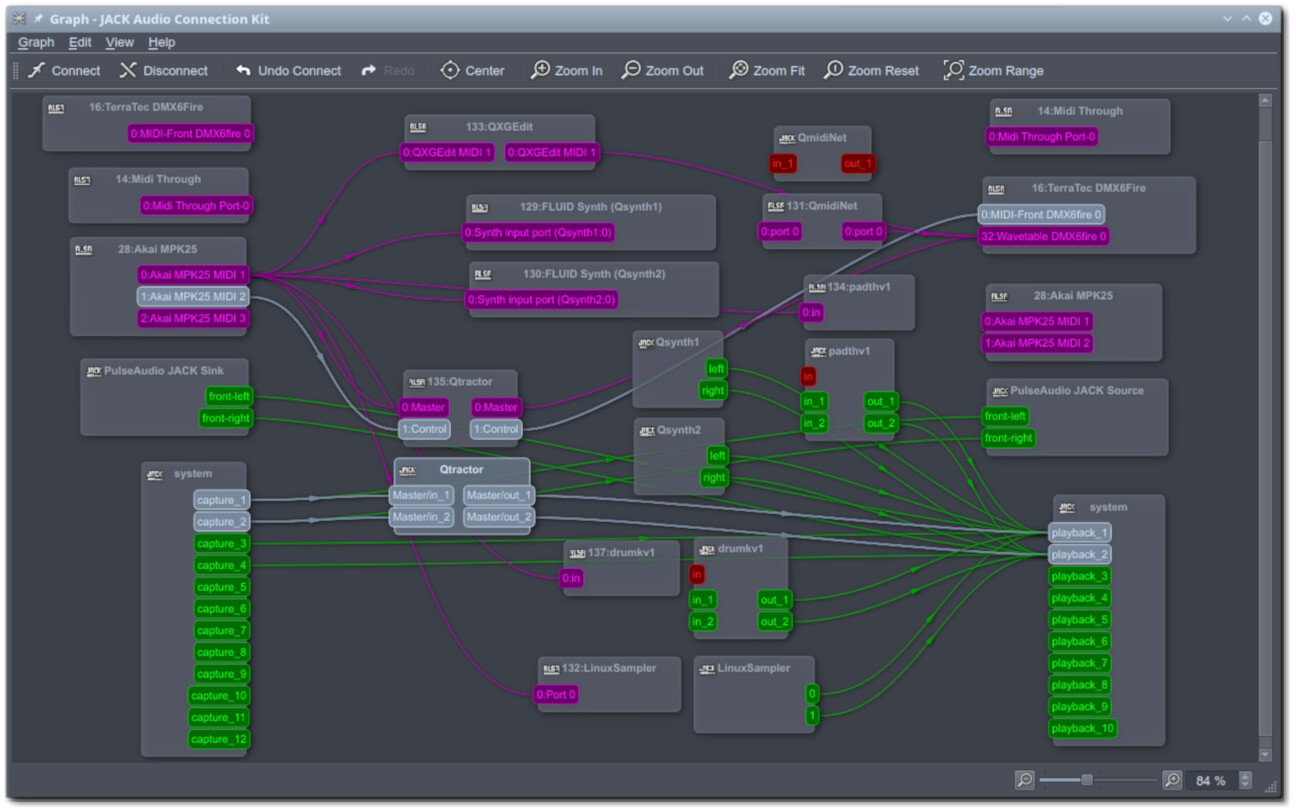
You should probably be using JACK and pipewire. If that’s the case, check out QjackCtl, a GUI frontend for JACK that lets you check and route everything visually. That might give some insight into why Plugdata is different than the others. Or switch to ALSA, which is way simpler at the cost of internal latency and see if that fixes anything.

In terms of audio interfaces, use class complient or buy focusrite. They have great support for their newest series.

In terms of class complient. The linux alsa sub system has a framework to deal with all sorts of class complient interfaces. A lot of interfaces are like 90% class complient, but have little specialities here and there. The sub system has a configuration matrix, so the kernels usb audio driver can be configured. The driver calls these cases “quirks”, you can find that term in the code and manual. Even if you can’t code, or read the details of code. The comments and names of variables/constants in the quirks file will give you a strong indication if your case as direct product or DAC chip in the product has been tackled by the kernel devs. For the DAC chips, i advice to find the pictures of the DAC boards inside of the audio inerface or even ask the manufacturer.

Anyways, have a look:

1 Like

Hijacking my own shit here to maybe extend the concept toward FOSS / Linux discussion, within and outside of production. I can’t append this to the OP for some reason, but I think it could be great to have a sort of catch-all thing going on for people doing stuff with Linux / FOSS / etc.

Virtualization, SBC projects or whatever else are absolutely welcome to share the space, too :smiley:

1 Like

Things have taken a very strange turn, and, gulp, I’m off of Windoze indefinitely. It was a fight to the death, and since 11 doesn’t like playing nice with anybody else, I decided it was time.

Not sure how this is going to go, since I tried emulating VM & FL in Wine and they don’t seem to actually work (I suspect the people claiming FL works this way are probably using those ‘alternative’ versions), but at least I’ve got a fair amount of power tools here.

I’m not sure if making music / art is really going to be the same after this, but here we go. I also figured this could be a cool little hub to attract Linux users, so hopefully any of us using alternative setups can sort of sponge off of each other.

NGL, this is either the smartest or dumbest thing I’ve ever done. Time will tell :laughing:

2 Likes

I have a few friends who have fully taken the plunge! I have a daily driver that I run Debian 13 on, but still have a windows machine for gamin and music stuff (not that I’m ever really doing DAW things, it’s just there with the hope that I return). I have my fears as well but there’s really good distros these days. What did you end up going with?

Ubuntu seems to be the most stable so far, so that’s what I’m test-driving (I say that, even though it’s kind of permanent now). Bitwig and Renoise are working fine, Sonic Pi is shitting itself (time to debug, I guess!), PlugData seems usable. Some other rare gems seem to be working under Wine, but it might just be a module away from breaking down, lol.

How’s Debian running for the most part? I know they’re not too far apart, but sometimes they have their own little quirks / character going on

1 Like

I’ve hopped all over the place with Linux. Ubuntu, parrot, kali, mint, (arch for maybe 3 actual seconds)… surely there’s been more, but Debian just feels like home for me. Haven’t done too many audio projects, but I think it’s capable if you put the work into sculpting the system to what you want. Just been doing coding and some compsci experimenting with it, and for that it runs smoothly

2 Likes

I have to admit, I’m a little envious of your predicament. Part of me really wants some circumstance to push me over the edge. Excited to hear how you get on and what problems/solutions you come across. Please keep us updated!

2 Likes

This is pretty crazy. I haven’t even had to make any DIY tools yet because of all the crazy CLI apps I keep discovering for audiovisual manipulation. What might end up being really fun is bash scripting for batch processing, since a lot of things can just be passed to other tools with very minimal effort.

OBS works just fine (so far), Multiphonics CV-3 is weirdly working great under Wine, and I was already using Kdenlive before all of this because any of those needs are really basic. I also forgot Reaper was on here, so even simple audio scripting isn’t totally off the table.

I’m guessing virtual audio cabling is just a matter of finding the right tools, too, which I’ll have to figure out next. It’s weird that any upgrades or tools are just free, waiting to be strung together. I’m hoping I can come up with a makeshift version of FIlter Forge, because as basic as it is at its core, it’s the one thing that allowed for really rapid image manipulation.

2 Likes

It’s nuts how easy and extensible this is in Linux. Basically a convoluted solution you pay money for on Mac and Windows is baked into the Linux audio system. The solution depends slightly between Pulseaudio and JACK, but look into pavucontrol (Pulseaudio Control) and qjackctl( (JACK Audio Connection Kit) as a handy way to manage audio ‘ports’ and routing.

qjackctl in particular seems like something you’d get along with given your love of patching lol

3 Likes

This was definitely the worst decision I’ve ever made; wine, yabridge and all of that shit looks excellent on paper until you realize the thing you want to use was last deemed ‘working’ 7 years ago and clearly you’re one of the few people who even cares about it anymore, and you get to find out firsthand (checkmate, regurgitating AI bullshit) that the hive mind is sorely mistaken, and it genuinely doesn’t run on current setups. FL Studio is 100% broken, despite reports saying otherwise, which leads me to believe that these people are using the FileCR edition or something. Simply toggling a dropdown menu crashes everything.

(Slight tangent, but it’s the same shit that used to happen back when I was a sailor scumbag - some guy tells you a questionable piece of software works because they tried it for two seconds, but their ‘secret patch’ doesn’t actually unlock crucial features that they themselves don’t understand - this is just the legitimate, community-friendly version of that.)

Bitwig has way more bugs under Linux than Windoze, too. I run into bugs frequently in both, but with Linux it’s pretty much an immediate guarantee that you’ll need to restart a project, even if you’re just jamming. The Grid does that thing where it won’t let you add more modules until you save and restart, and that’s if you’re lucky enough for it to let you save at that point at all.

CLI tools are cool, but the documentation isn’t always immediately easy to understand, leading to a fun easter-egg ‘examples’ hunt. Most of them seem to be pretty old, sort of like ChucK or Csound - they do excellent batch work, and they tend to be extremely fast… but this is obviously not a DAW anymore. This is like making art with random household objects and a small tape recorder instead of pulling out a virtual instrument in a real workstation.

Even tools like ChucK’s official IDE (and possibly ChucK itself) are in dire disrepair; I got a stupid robot dick to walk me through patching every hole, and after a few hours of whack-a-mole, it finally worked… and then I realized that ChucK seems to run fundamentally different depending on your OS. The same code wouldn’t work like an oscillator+filter array like it does on Windows, almost as if I was using some old version that didn’t even have that feature yet. I didn’t get tangled up in version numbers in order to figure out why this was even the case to begin with, but the lack of a dark theme on the outdated IDE was painful enough to stare at.

As much as I love going off into the weeds when I have the time, when it becomes a necessity, it’s a roadblock. I wouldn’t wish this on anybody, lol

2 Likes

Wow, that sounds awful. Sorry you’re having so much trouble with it.

Did you try Reaper? I’ve always sort of had that in my back pocket as a possibility if I have to ditch Windows, but I don’t know if it’s actually usable or like the stuff you’re talking about where it’ll launch but you can’t actually do anything long term with it because it’s so busted.

1 Like