you have me sold
I don’t have enough spare change for some kind of ‘smart’ EQ, but I used to use this one back when I was a dirty pirate whore. Now I’m starting to wonder if I’d actually be able to make a decent one and not have to pay anyone for their juju.
I know it’s not the same ballgame, but after implementing some cool auto-contrast / auto-brightness stuff on the pixel array of images that I kind of liked the outcome of, I’m thinking about maybe taking a similar approach to audio. If anyone else is interested, I’d love some suggestions and I’ll obviously share builds as they happen 
1 Like
It’s been 3 years and there are now 2 multiband clippers on the market. However one of them does not have linear phase filters between the bands and those filters noticeably color the sound if you use inverse phase to listen to the delta (Kazrog K-clip) and the other only has softclipping with no option to adjust the transfer function to a harder, cleaner style (sound theory kraftur).
Seriously devs, the pieces are out there, I am waiting to give you my money as fast as you will take it.
1 Like
I think the basic building blocks of this idea aren’t that hard to put together, it’s kind of like OTT where you are using multiband compression to push each band to a specific gain level. Just with a lot more bands, and a bit more gentle compression/expansion settings to make things a bit more transparent.
My understanding is one of the keys is getting a good target gain range for each band. Gulfoss straight up uses a waterfall near their HQ. Pink noise is probably a safe starting point. I know Elevate has a shaping function in it that is closer to pink noise, but it has their own tweaks to it.
What I don’t know is if the bands are aware of other bands and reacting to that. Like if the 2khz band has 6db of signal less coming in the the 1k and 3k bands, is it just blindly adding an extra 6db of gain to put everything in line or is it weighting the fact that those other bands are louder and splitting the difference? And for how long does it allow that if so? Is there a short window where adjacent bands are allowed to be different from their neighbors, but after 500ms they get pulled in line? Those are the things I suspect have to be decided by code under the hood for the interface we are given with something like Gulfoss to just work.
1 Like
That’s definitely the part I want to experiment with the most – if I can get things to kind of unrealistically flatline at some kind of speed and then have the user be able to dial the effect back so it’s not so unnatural, that would be cool enough for a start
I might just start with a 3-band prototype and then see how many more make sense to add. I bet it’s going to get tricky, but I could see it being a really fun design tool, especially if it doesn’t use compression in the traditional sense (even though there’s a fine line!)
This seems potentially doable. Have you tried just routing 3 instances of Clipmax through FL’s multiband splitter device? If you do it in Patcher, the sends are exposed and it’s easy to configure without having to send to additional mixer tracks.
I know it’s not the all-in-one solution you’re probably looking for, but it would definitely work.
In either case, I’d love to gloss over some algos & formulas and maybe make a version of this in Plug’n Script while I still have time on my hands for shit like this. Great idea, by the way!
Hmm… EQ design is eluding me. I’ve honestly never tried it until now.
I set up 3 bands, an I/O, and corresponding knobs that act like VCAs, but as anyone smarter than me could guess right off the bat, lowering the volume on the EQ bands just gives me the normal I/O you’d get without any bands to speak of, since it isn’t substantially reducing anything. I’m successfully able to add the bands’ outputs to the signal, but this doesn’t work for lowering.
(Probably phase inversion, once I figure out how to exactly implement that)
Might have to rabbit-hole this one after trying the clipper idea first. I guess most clippers just smash the signal to zero dB and allow the user to attenuate the inputs and outputs, but there’s quite a bit more than what meets the eye for that, too. At least that seems more basic for starters.
If anyone’s got some resources or knows any tricks, you’re my hero.
I totally forget patcher exists. I am the guy who uses 4 mixer channels as sends for a single sound to get the effect that I want.
I have Kilohearts multipass too, I really have no excuses XD
I made a really simple one if this helps! (This should simply let you DL immediately)
The forum doesn’t let me upload presets so I end up just doing it this way for the hosting ability
I checked out the presets and they were all preloaded with a million compressors and soundgood-whatever-the-fucks so I just put a few transparent Fruity Balances in so that it’s easy to control and extend further in whatever way you want.
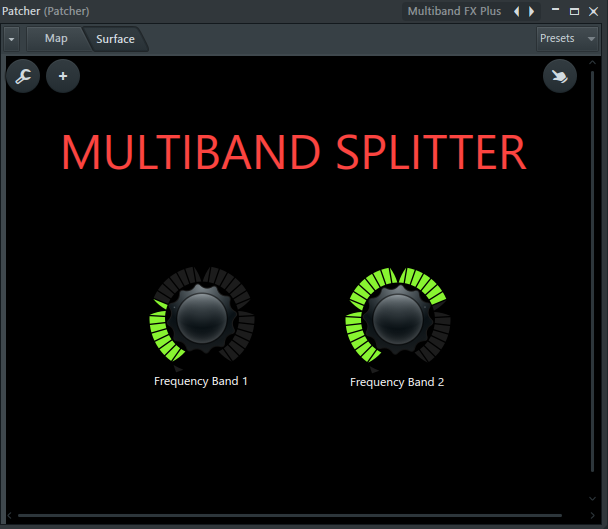
2 Likes
Thanks dude, I’ll take a look when I get home tonight.
1 Like
Kind of a blast from the past here, but I cracked the code on this one (in Patcher, no less). As stated years ago, this is just simple FX-multiplexing, but a more lightweight solution is ideal.
Patcher is probably one of the most lightweight high-level environments I’ve used in my life, so…
Formula controllers basically create a gate at sliced intervals in relation to the songtime, so it switches everything off and on in a sequencer-like fashion. It’s basically just a timed 4-to-1 switch right now where Fruity Balances are used as mutes / controlling what gets switched on while all of the others switch off, but I’m looking into better sequencing ideas. Possibly random values related to the Songtime() mod?
The challenges of working with patcher vs the ease of working with patcher. I can’t wait until they add a goddamn copy and paste, that’ll save me an hour.
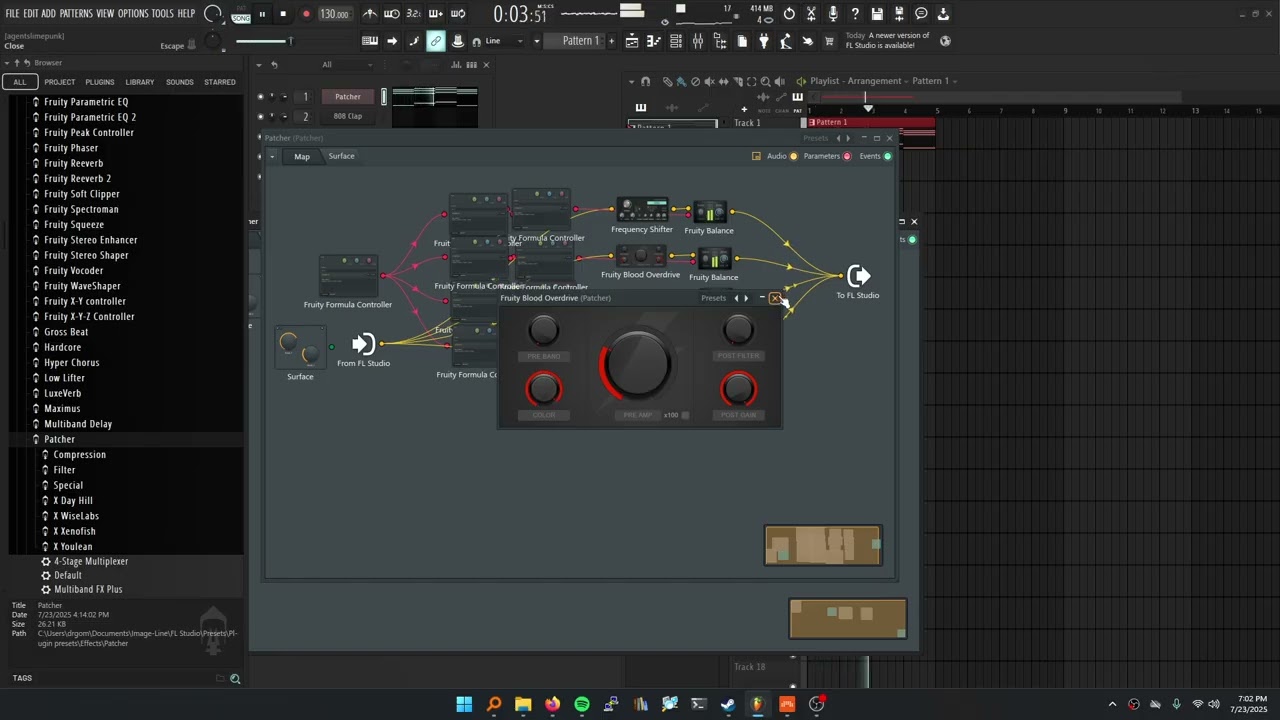
The only thing that sucks about adding 8-16 steps is that all of the conditional values, balance volumes and everything else have to be entered in by hand. 4 Took forever as it was 
Edit: I’ve moved this puppy over to Reaktor for easy scaling. Now I can have as many chains as I want, and duplicating each set of modules just creates another output. Checkmate, patcher
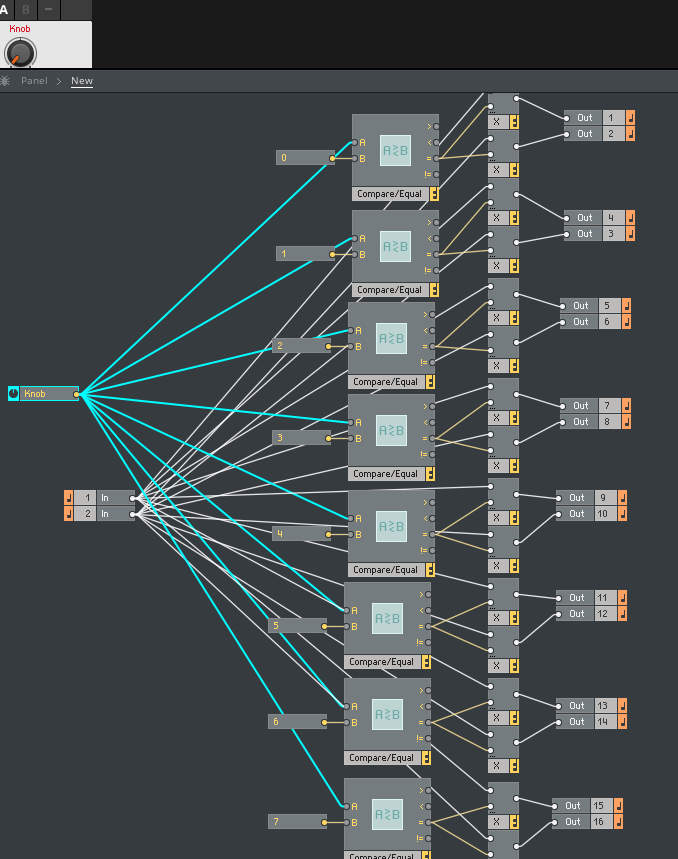
Something is making me think that MIDI-controllable chains could even be cool for this 
1 Like
Probably a more fleshed out version of Nimble Kick - sorta like a bass warper of sorts
FL’s basic warping settings just suck for kicks and any intricate bass sounds, but using nimble kick isn’t the best for everything.
I’d also make a Zaag synthesiser. If people can do it with 808s (808 cooker) then they should be able to do it with kicks.
Do you like the warping algos in Vital? Or do you need something more robust?
Also fitting that when I googled ‘Zaag synthesiser’, people were just using vital for whatever that is. Maybe your perfect plugin already exists? lol
You forced me to get off my ass and update FL studio, and then I finally pieced together something in patcher. Saved my clipper with crappy autogain (turns out good autogain is NOT just opposite gain at the beginning and end of the process) as a preset. I’d still pay 3 figures for someone to do it better, but I have something that works and I will put it head to head with the good shit some other time.
Thanks man. I’d share my preset back but unless you have Kclip it isn’t gonna load. Also I’m sure you can throw together an autogain, which is all I added besides the clippers.
I might try running this with Goldclip for the lulz, but one instance of goldclip in a master session is on the edge of what my PC can do, so that would not be a usable plugin.
1 Like
I don’t have vital, I generally use serum 2 for all of my synth needs, but all of the stretching methods fuck with the kicks.
Mmm, yeah you can make zaag kicks with serum and vital, but it’s a whole complex process. I’m talking something that basically does everything for you, like 808 cooker, as I said.
You start with a synth sound for zaag kicks anyway, usually it’s just a saw wave with a shit ton of eq automation.
This reminds me of hardcore back in the day where the whole point was to resample a kick for like 2 hours straight before it was done. Not the right amount of resampling, just as much as you could bear to do. It was a badge of honor to suffer through the process of making your own hardcore kick. Zaag sounds kind of like a modern interpretation of that, where the pain of the process is the point.
Not that I agree with that, I agree with you that if you have the correct tool for the job then your art isn’t improved by suffering and doing things harder with an incorrect tool just for the sake of making things more difficult for yourself. These days you just use a sample for hardcore like any other genre because that particular sound is in sample libraries now. I’d say do the same for Zaag - just lift someone else’s kick, put your spin on a mostly finished sound, and move on.
1 Like
I like how googling Zaag actually just led me back here 
So is an 808 into Ohmicide getting any closer? I’d love to come up with something that makes the process simpler but I’m not finding any real parameters or much of a process so far at all. Distortions are usually really easy to implement, but finding the right combination of flavors for the process could be really interesting.
I also really like the idea of a kick-maker for people who find Vital to be too much work. It’s definitely been done before, but your idea is likely unique enough to work. Now I need to go fill my old man brain with the idea of ‘zaag’ 
1 Like
I get your point but respectfully have to say:
Hell no.
It’s very taboo to steal somebody else’s kicks in any way, and because zaag kicks are so intricate and structured just adding extra fx or similar isn’t an option. It’s better to create a whole new kick in your own style.
And that’s another key point, everybody has a slightly different style of kick in the hard dance community, and it’s really easy to notice if you’ve yoinked one person’s kick to use for yourself. In pre drops, sure, but never as an actual drop.
It doesn’t really matter how one makes a zaag kick, the key points are simple:
- They have little to no transients
- They are very distorted
- They are full of bass
- They are usually a single tone
- They often have a “beep” sounding punch (again NO TRANSIENTS!!!)

Again, you can use whatever method you want, but any sustained bass sound works well.
I can send you a DM with my method for making zaag kicks, if you’re interested 
1 Like
Oh, that’s interesting! So it almost doesn’t need an envelope, or if it does, the attack swells rather than the opposite. That actually might be even easier to create in theory, since it’s almost like a bass sound without a whole lot of complexities.
I’ve definitely heard this type before on hardcore-style tracks. This seems like a good challenge because it’s way outside of my comfort zone . Also, if you have a method that works, I’d love to base whatever I make with your style in mind!
Zaag kicks are the easiest to make out of all kicks, and they’re indeed controlled by an envelope on the sub level.
I’ll send you a DM with my method and some other tutorials 
1 Like