This is a companion discussion topic for the original entry at https://www.youtube.com/watch?v=Erv0YLW95C4
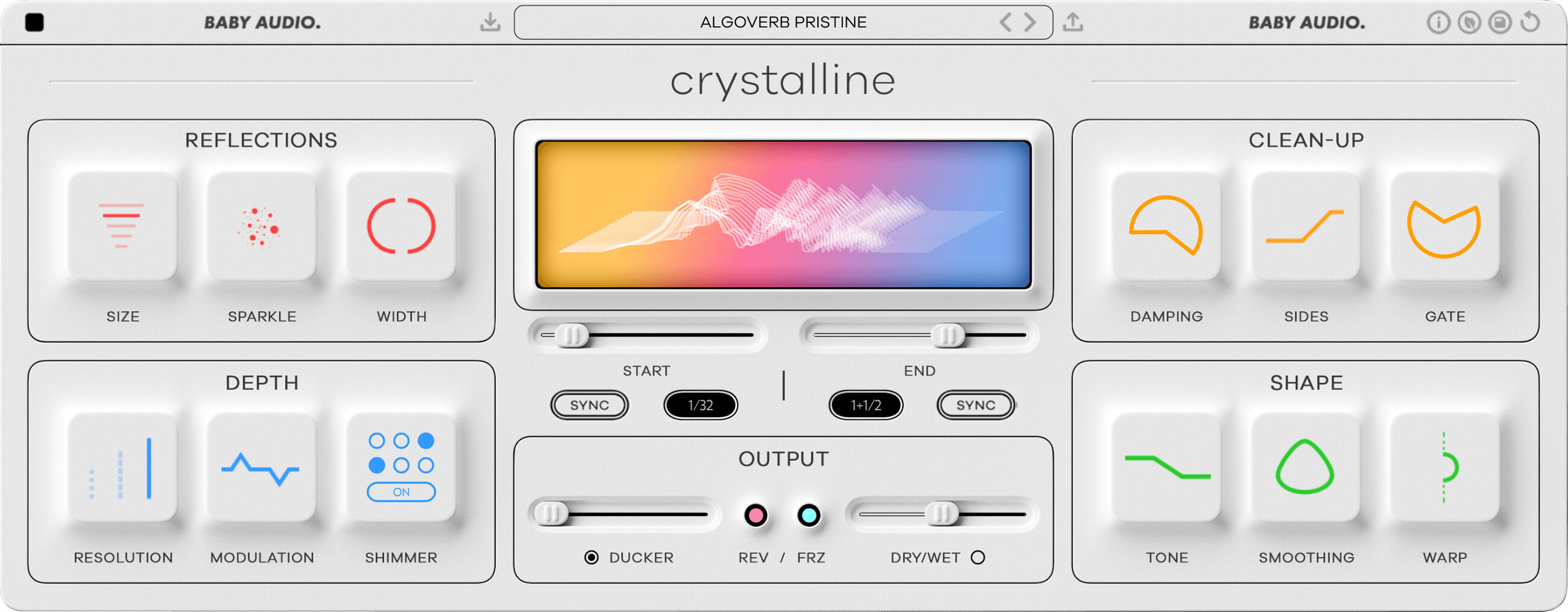
I just watched the official tutorial for BabyAudio - Crystalline. The possibilities seem pretty interesting.
They currently have a pretty good deal (price = $29), so I’m likely to get it (although I probably don’t need another reverb)
Wondering what our reverb aficionado/expert @White_Noise thinks about this one?
I have this along with 75% of baby audio plugins. I have used it quite a bit but can’t say it’s great objectively. I have been able to find sounds I like though. I cant give a good yay or nay to it.
Which one(s) would you recommend then? I tend to stick to u-he’s reverbs, as well as NI’s ReplikaXT and MorphVerb from UnitedPlugins.
What I found intriguing with Baby Audio’s are the ducker, rev and other fun things that I don’t remember seeing on other reverbs.
My take is that reverb is mostly important for rock/pop bands, where there is space for it due to scarcity and/or well defined instruments that don’t impede on each other in the mix. Of course, you can decide to drench your music in reverb (hello, shoegaze bands). Not my thing when it’s overdone.
For electronic music that’s heavily layered, it doesn’t seem to matter as much? Also, most synths incorporate reverbs in their FX arsenal so you’re likely to use that when building or tweaking a sound.
PS: re-Baby Audio, I have Transit 1 & 2, Spaced Out and Parallel Aggressor. I hardly ever use them.
I think this is a great point. It’s so easy to slather that shit everywhere (in the synth, on the track, on the bus, etc) and then wonder why your mix is muddy. It’s a tricky thing and can get away from you quickly.
For me, reverb goes in two boxes - as a sound design tool used during sound design, and as a spacial placement thing like it’s traditionally meant to be used, and I feel like that really needs to happen during mixing. Just like EQ, reverbing a solo’d track can make it sound awesome on its own while making it basically impossible to mix down the road. And like most things, anything you do during sound design have to be taken into account while mixing.
Moreover, at least for me, there isn’t a lot of overlap between the two things. Like for sound design I don’t usually need a pristine, room-perfect reverb, that’s for later. I either need interesting, weird reverbs or just about anything will do because I need some sort of source material and it doesn’t have to be super high quality.
I lean toward disagreeing with this. Since electronic instruments are (generally) not amplified in a room, there is no sense of space. Humans are not meant to hear things in an anechoic chamber. Reverberation is as natural as the rain and wind. So, when we hear an instrument in isolation, it feels very *close*. This is OK if that is the sound you’re going for (see Radiohead - In Rainbows Album - “Weird Fishes” Song in particular) and it can be used to your advantage, but it really all depends on how you want the instruments to appear in the stereo field. If you visualise a mix in 3D space, Frequency gives you up/down (height), Panning gives you left/right (width). Phase gives you in-front/behind (I call this depth in negative space). Reverberation gives you close/far (I call this depth in positive space).
I think Reverb is important no matter the genre.
BA-1, Atoms and Super VHS are my most used from BA. Transit 2 is pretty good and offers improved sound quality over Transit 1.
Good call being interested in this for the reverse, ducked and tempo options.
I don’t really like the sound of this one compared to my usual reverbs, but I do still whip it out on occasion for the rhythmic/sound design options. The ability to tempo-sync pre-delay is low-key very nice to have.
I’d like to recommend a better sounding alternative, but I don’t know of one. Just run this at max quality on a send and process the input/output sound to minimize whatever artifacts stand out to you. For me, I can’t get this thing smooth/diffuse enough, so I’m running it in series with short reverb just to break up the early reflections and get them a bit more diffuse (something like vintage verb or valhalla room on short settings can work here). Experiment with putting that second reverb before/after Crystaline - that will affect the timing a bit, which again is the main strength IMO of this reverb.
EQ pre/post is often also needed. If you have anything like Soothe (or maybe Smooth Operator since we’re talking Baby Audio) that can also help on the input side, just to take some of the heavier harmonics off so they don’t stand out in the reverb tail as much. In fact, that’s a free trick from me to all of you for any reverb when you feel it just piling up all in one spot.
Interesting convo about how to use reverb in electronic music. I come at it from a very… literal? point of view. That is to say I’m picking up on a few different ideas people have already mentioned. Sometimes I use reverb to put sounds together in a space (usually my drums, which are a hodgepodge of whatever samples I thought sounded good on drum selection day) and give a sense of cohesion. Sometimes it is there to help an instrument sound more natural if I’m using something like an orchestral sound that I want to not sound weird or off. Sometimes it’s a combination of the two, maybe I want to pretend that my synth pads and synth leads are being re-amped or played in a nice space together.
There are some elements in most of my mixes that don’t get any reverb though - usually bass and some select drums.
If you think about it, we talk about reverb as a spatial effect, but it’s literal effect on sound is in the time domain. So when I have elements that are critical to control very precisely in the time domain, and I have the option to maintain perfect control over them even if it means they sound a bit less than natural, then I quite often leave them bone dry.
On the flip side, when I know I need to grab a reverb is when I’m hearing too much dead space in a mix (which can happen when I’m still in the composition phase) and I don’t want to add more sounds to it. The right amount of reverb can fill in that space in a way that makes musical and physical sense, without me having to re-write a part I like. Sometimes, and this is more rare, I might have a preset with a verb that I like and work it into the basis for a track. At that point, I can start to modify the reverb settings (or recreate them in a more fully featured plugin) and mold the reverb into the track as it starts to take shape.
If you want to talk specific plugins, I can get into a sort-of tier list of price, complexity, and sound quality as ranked solely by me. For what that’s worth to anyone. The frontier I’ve been trying to reach for years is reverb that can animate itself dynamically, cleanly as seamless effect, and I think the tools are out there to make that exist now but I haven’t had the time to really learn them and figure out how to make it happen yet.
well, bringing this back to the OP, i got Benn Jordans reverb collab plugin called Taps & Portals by Lunacy audio. He reckons it’s the closest thing to behaving like an analog delay verb.
not sure about it yet. I tried it on my compilation track but in the end i ended up using Recirculate as it sounded more natural to my ears. Wish I had an Echofix EF X3 
Can someone build a combination plugin reverb(convoluted optional)/pitch shifter/eq
Where you can pitchshift both the wet and dry signal with a mix option for the amount of pitchshift…
And eq out the unwanted frequencies….
Sorry tangent….
I do this with stock plugins but still it would be cool to have a combination plugin like this….
I mean there are dynamic eqs which are basically a multiband compressor/limiter + eq…
So yeah…don’t mind me…
Sorry for the tangent.
This is almost exactly what I want. Or maybe it’s not a pitch shifter, but a spectral reverb that can dynamically adjust the decay times of various frequencies based on the input spectrum. Once it’s doing that, it is just a short jump to have resonance supression/dynamic eq on the input (before or after the spectral detector). But once you have a spectral engine that can do all that, pitch shifting shouldn’t be too much work, again dynamically based on the input signal.
Fabfilter Pro-R2 is kinda sorta close. It’s not dynamic, but you can EQ both the input and (very helpfully) the decay rate of the various frequencies. It’s a pretty powerful setup where you can actually drop an impulse response in and it will use those EQ curves to recreate it - algorithmically. Which does allow you to completely decouple an IR’s time response and frequency response. Very cool, though I haven’t used that feature once yet (I’ve actually only used IR based reverb like twice in 10 years).
I got Liquidsonics Tai Chi a few months ago during BF, have not had a chance to dig in yet. I don’t remember if it can do this all dynamically (and it’s definitely NOT doing it with spectral processing, you get 3-4 bands max), but it has a lot of power hidden under the hood, and I think you CAN treat early and late reflections differently with a fairly smooth crossover between the two to morph reverb over time (kind of).
Right now, I can kind of make this happen by using a couple different sends with one shorter and one longer reverb (with enough pre-delay to come in after the short one). But, even then the two reverbs and their relationship is still static. The balance is finely tuned and I can’t really automate it. What I WANT, is to be able to set up a reverb so that as a sound plays it is all around you in full range and then as it dies off you can hear it physically drifting away and echoing out for longer and longer, getting more and more filtered, and maybe throw a subtle pitch shift in there so that you can tell it’s not the original source anymore.
For now, the answer is to use your reverbs on a send full wet where you can drop processing on the audio before it hits the reverb without affecting your dry sound, and drop processing after the reverb to affect only the wet sound. The one thing you can’t do (that I’m aware of) is have processing in the feedback loop of any reverb out there, which for different reasons is what both you and I want.
I have done quite a lot of experimentation with this, and my guess is it’s a practical limitation rather than a technical one. Basically once you start inserting processing into the FDN matrix, shit gets out of hand really quickly - you can go from something musical to insane, unusable noise with a small change because the feedback network means exponential changes that compound depending on the matrix.
Another problem is that most of it doesn’t work like a user would expect. Adding chorus in the feedback network doesn’t result in a chorus-y effect, it usually gives you either AM or harmonic distortion depending on the incoming signal. Which is cool, but if you’re Joe User that just downloaded the plugin you’re gonna be real confused and probably frustrated.
It also adds a growing complexity to the interface. I’ve got a Max patch that implements a couple of wavetables with selectable modulation and a basic delay network - nothing crazy, you could do it in most big synth VSTs. But mine has 56 parameters/knobs because it exposes everything, some of which don’t do what you think they’d do unless you’re intimately familiar with how it’s structured. These things quickly explode in complexity and you have to find ways to make it usable.
It’s a huge design consideration if you’re shipping something to other people, especially something as complex as feedback modulation/processing - you have to make decisions about what people might want while keeping the clutter and complexity down, scale things to a range that users might want, and most of all identify the ranges and combinations that people would most likely use, all of which is a shitload of work.
I guess the tl;dr is what you’re talking about is doable, but a Sisyphean amount of design and testing for someone that wants to make a reverb plugin that people would pay money for.
Ive created reverb feedback by creating a weird envelope gate in maximus dialling up the release and the gain and leaving the ceiling at a moderate level after I run an instance reverb in the previous mixer channel slot…then add some reverb after maximus and the finally control the dynamic with a limiter and eq out the unwanted frequencies.
In fl the stock reverb you can turn off the dry signal completely just record the wet signal in real time with edison and effectively sample it.
And layer the wet signal with whatever processing against the dry signal sample.
A multiband spectral convoluted reverb pitchshifter transient shaper compressor eq combination plugin….

A producer can only dream.
I guess there’s always max pure data or max4live or creating patches in fls patcher.
I got some interesting results by loading processed synth samples in fls stock convoluted reverb plugin…
To get super weird interesting sounds.
you could use Matlab to create a ray traced impulse response with the absorption coefficients set high in the frequencies you don’t want and then load the IR into your favourite IR plugin. Not very dynamic though 
See, that’s always the gotcha! I have 101 different ways to create the exact space I have in my mind. But the second that space needs to change in response to the dynamics of the input, nada.
shaperbox he’s probably the closest thing in Production that I know of. The fact that you can split any shaperbox element into three bands is pretty good.