Aka the thread were some of us use our imagination to have mindsplosions about the math and physics aspect about music and art in general…
Notice how notes are defined by frequency ratios in relation to each other in terms of octaves…and chords are defined by combining these notes in different ways to produce an overall greater sound…..
All different sounds you hear are just a bunch of sine waves. The reason a saw wave is used for subtractive synthesis is because it has every even frequency along the Fourier scale, thus making it the most harmonically complex and best starting point for interesting sounds, that of which usually include boosting certain frequencies and creating rythmic phasing. (Eg, an acid bass or reese bass) Square waves are a lot more interesting as they only contain odd numbered harmonics, but can be produced with any bipolar waveform given enough volume and clipping. The interesting thin about a square wave is that it practically only contains the values 1 and -1 along it’s slope, but when used as a frequency modulator at absurdly low frequencies it doesn’t seem to show that nature. The simple alternation of 2 points actually goes to the triangle wave modulator.
Also just a neat thing to remember from my beloved the FL studio Sytrus video, the slope of a sine wave is a cosine wave, which is just a sine 90 degrees out of phase.
Maybe not entirely math focused, but synthesis theory always tickles my brain.
Honestly, I think most people are better off having a blast with Midinous, FM synthesis, or modular. Or if you’re a nerd like me, Sonic Pi, coding modules, or some simple DAW scripting.
Unless you’re really creating your own filters from scratch or something, I don’t really know how much mathematics you really need to introduce into the equation. Most people are better off learning how to use a S&H or slew limiter before they get ahead of themselves. Hell, most people I talk to don’t even know what a macro is. You can accomplish a hell of a lot with some really basic tools and some interesting routing schemes.
Reinventing the wheel sounds cool (I’ve been there many times, myself!), until you realize you can just build something small on top of a larger platform and use it virtually anywhere, and spare yourself the rabbit hole of diminishing returns. It’s the best of both worlds, and we’ve pretty much got all of the goods on tap, not to mention most of the crazy ones are FOSS. Most people aren’t even using them.
(Not to dissuade any future plugin developers - if that’s your calling in life, do it!)
If you want to try out some math juju and experiment with patterns, you can always start by firing off some MIDI in VFX, SP or Bespoke. Grab a MIDI loopback and the world is your oyster
90 degrees (π/2), but minor nitpick. For sure, the big takeaway is understanding that sin and cos are the same thing offset from each other. A little trig can really help understand what’s going on under the hood of a synth.
This is really a beautiful thing to grasp, I think. The fact that any signal can be decomposed to sine waves is fundamental to any kind of audio synthesis and is also in a lot of ways the cornerstone of modern civilization - networks, wifi, cellular signals, electronics, basically any modern signal processing has it’s roots in Fourier’s work. Much like all of electromagnetism being described by Maxwell’s equations, the Fourier transform is a shockingly simple result that describes so much of the world.
I dunno, I’m of two minds about this. On the one hand, yeah, if you can’t use the basic dummy-proof tools in your DAW, math isn’t likely to propel you to Ibiza. Should probably get a handle on things by RTFM and see how far you get. I’m also not sure that a lot of popular music genres benefit as much from a deeper mathematical understanding and application in music. You don’t need Calculus to shit out a Katy Perry backing track or arrange some 4-on-the-floor.
On the other hand, out on the edges, experimenting, not trying to wow the Nashville scene, I think it gets more useful. Having a good head for how things are working under the hood means 1) you can intuit how things will respond to changes and what might happen if you stack 47 flangers on a track, and 2) you can pick apart the basic building blocks of, well, anything and repurpose it in less conventional ways because you know how those Legos are going to fit together.
The thing is, you mostly don’t even need to do the math, you just need to understand it - shit like reading frequency graphs and spectrograms is just summarizing data, but if you don’t understand what that data represents, you mostly just have pretty pictures. The deeper your understanding goes, the more you get out of those representations. Understanding means you can read through formulas for things like reverbs and filters and compare how they work to have a better understanding of when they might be useful (and how you might abuse them) - or even use something like Reaktor or pd or Supercollider to implement them in outrageous ways using numbers that no sane commercial VST designer would allow. The thing is, someone way smarter already did the actual math and put it in the intertubes, you just have to be able to look at it and pick out the variables and constants and whatnot to get how it works.
And I’d argue that a lot of this stuff can be done with high school level math - Algebra, Trig, maybe some Linear Algebra, bonus points for just understanding wtf Calculus is. Stuff you already ‘learned’ (for two weeks until the test and then again for 3 days before the final lol) but most people don’t take the time to really grasp. And I don’t blame them, I blame the education system, but the fact remains that most people have access to the majority of what they need to understand what’s going on in their DAW or VSTs or modular or Moog if they spend a little time, and depending on what you’re doing I think that can be valuable.
I edited my comment a few days ago - I wrote that late at night and didn’t have many brain cells left
It’s also surprisingly easy to apply in a mixing environment. One of my mates is a super awesome jazz musician and when I was looking over his shoulder at one of his mixes in reaper he was doing the whole “bass section is responsible for mud. Once you understand how the science and maths behind it works, it actually makes sense.
I definitely don’t want to promote my small-brained outsourcing mentality, but this sounds like something I’d love to try with something like Pedalboard and some simple looping. I also say this as someone who’s not opposed to loading down Shade with 5-10 flagers and phasers at a time. If there’s some craziness beyond that point, I’d love to check it out without getting too far away from design – because once I do, then it becomes some other obsession
(A lot of people probably don’t struggle with that part though, so maybe switching gears is a little more fluid!)
If anyone gets far enough, I’d absolutely love to see or hear some video / audio captures. I’m also not opposed to tossing some up once I find a cool framework for experimenting in that doesn’t make me have to stretch too far away from the DAW . All of this is very inspiring, even to someone like me who goes fuzzy even when it comes to very basic math, so I’m excited to see how this develops!
I got a somewhat-cool result with 20 iterative phasers, as 100 and 1,000 seemed to be a bit much. I added a little bit of timestretching into the mix here but otherwise, this turned out pretty cool.
I’ve never used Pedalboard prior to this, so I’m definitely open to any requests. I made a cool little script if anyone wants to try experiments themselves
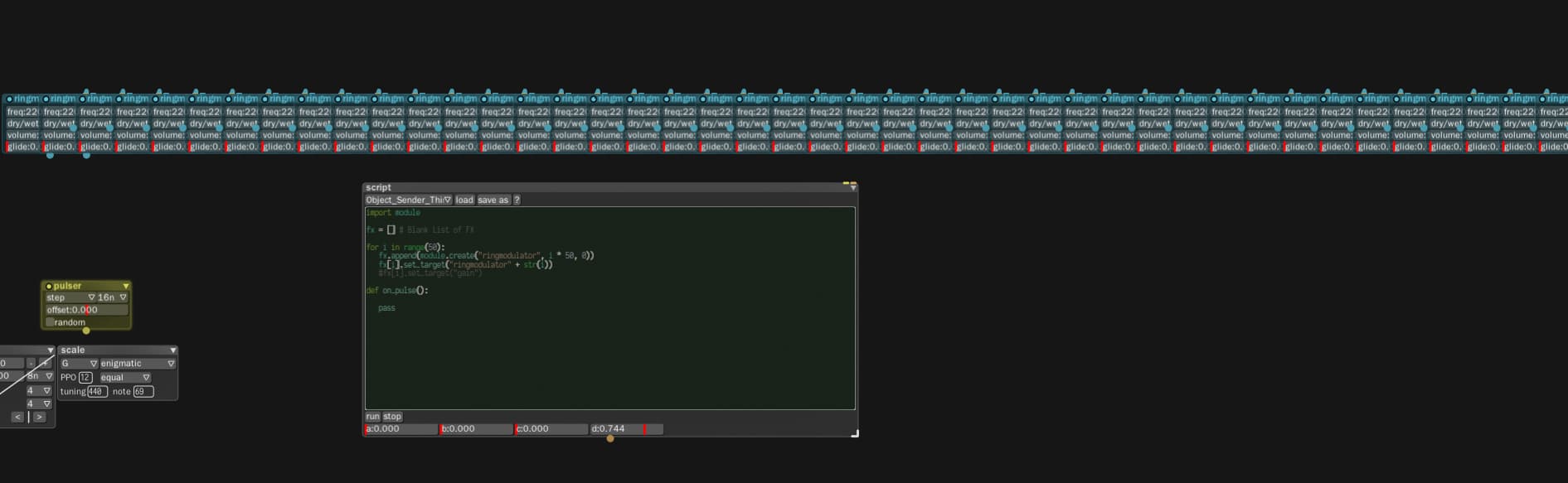
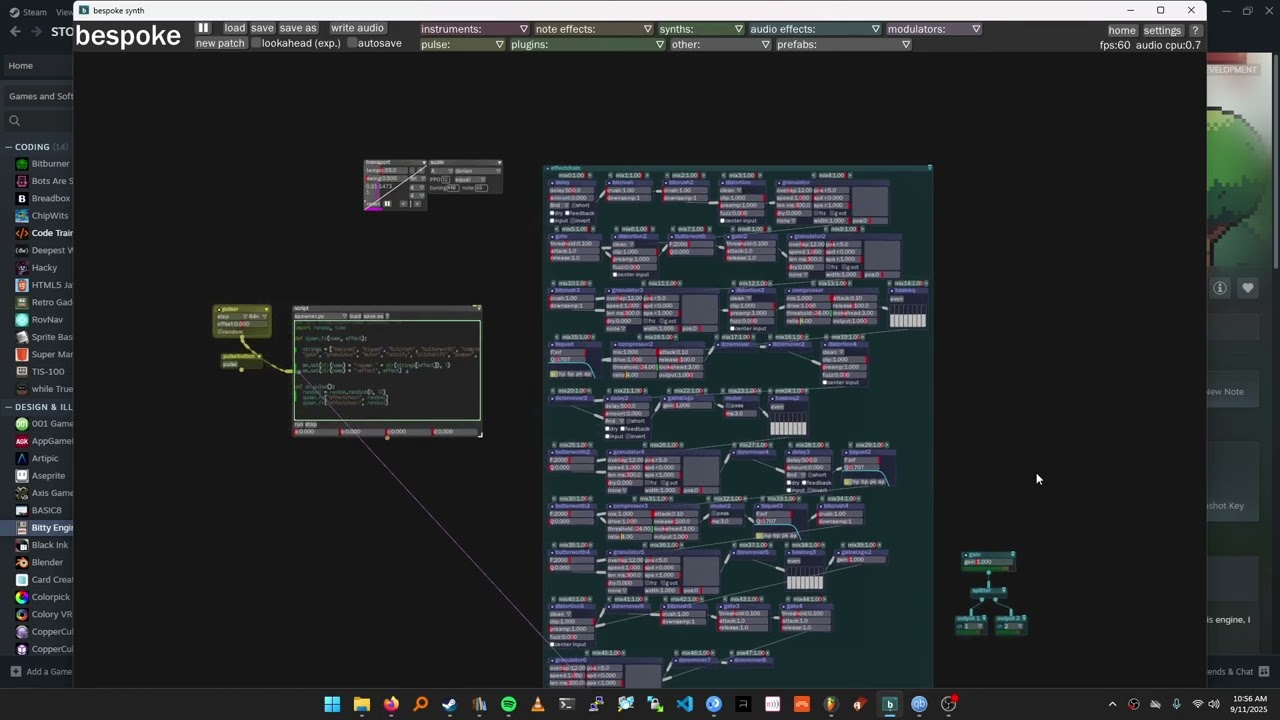
As it turns out, Bespoke might be a really happy medium for anyone wanting to sandbox like this. The script module lets you set up modules, as well as placement and patching all in the code, and you can even have new ones generate or shuffle around on clock signals.
I haven’t used much Bespoke at all, but this seems really intuitive already
It’s definitely for nerds and pretty useless to anyone else. I just got some insider knowledge on how to hook things up ever better with scripts from some contributors on discord, and it’s got a lot of insane functionality under the hood that hasn’t made its way into the documentation yet.
Long story short, you can spawn almost anything you want, wherever and whenever you want. I’ve never seen something like this before!
I had to get some insight from the dev who (I think) handles the backend of the script module, but this was directly inspired by this thread, if that counts. It seems like there’s an upper limit to how many FX will spawn when you do this, but the fact that my tiny little script randomly-generates a stocked Effectchain cracks me up. There’s some jank that I can’t control in the API (centered around toggling and spawning in pairs), but my workaround is to just spam it until it fills up.
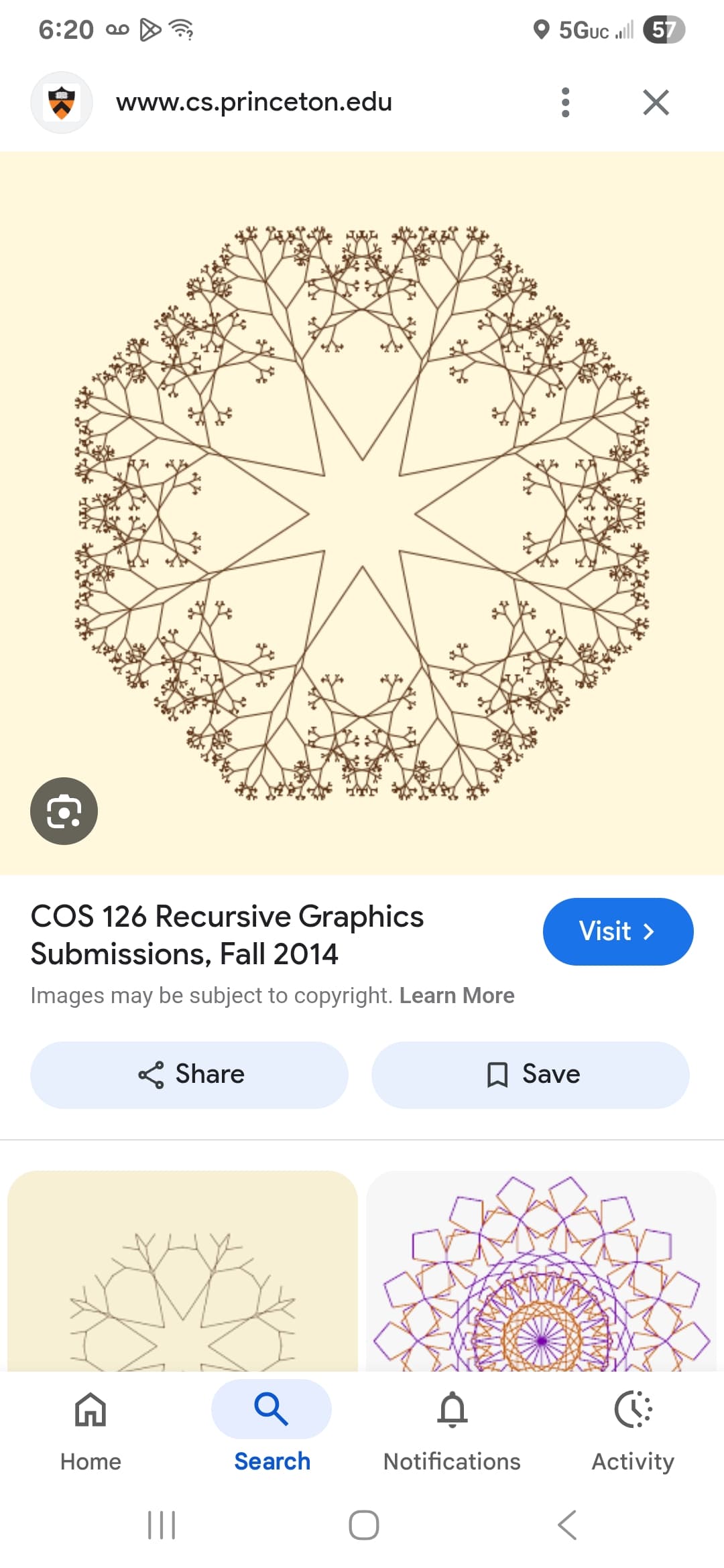
I also got some further insight into setting up mass-modulators, so having some randomly-connected LFOs and macros would be the next order of operations. Then I want to look into cloning the whole patchbay to make it even more r e c u r s i v e
Ultimately this is probably just the piss-poor version of BYOME or something, but I love the idea of being able to control everything in succession like this. It can also just add or remove new effects every beat or measure, which makes it even funnier. The self-modifying song!
This could be a really cool way for people using Pure Data / PlugData (or even Purr Data, apparently) to make those recursive functions and more complex modules without having to leave the PD framework. Kind of the best of both worlds, possibly.
I was never into PD at all, but this along with the easy encapsulation of even regular PD objects is making me want to really explore it a bit further
This seems potentially amazing, depending on the exact depth of it. I use Audacity macros all the time, but being able to load it down with effects in semi-random orders and quantities sounds like a potential here, too. I’d have to go over the actual audio FX and see if there’s anything extremely useful I’d want to use in this way personally, but it looks like the entire program is scriptable.
Might have to eyeball Reaper for similar purposes, on that note!



 . All of this is very inspiring, even to someone like me who goes fuzzy even when it comes to very basic math, so I’m excited to see how this develops!