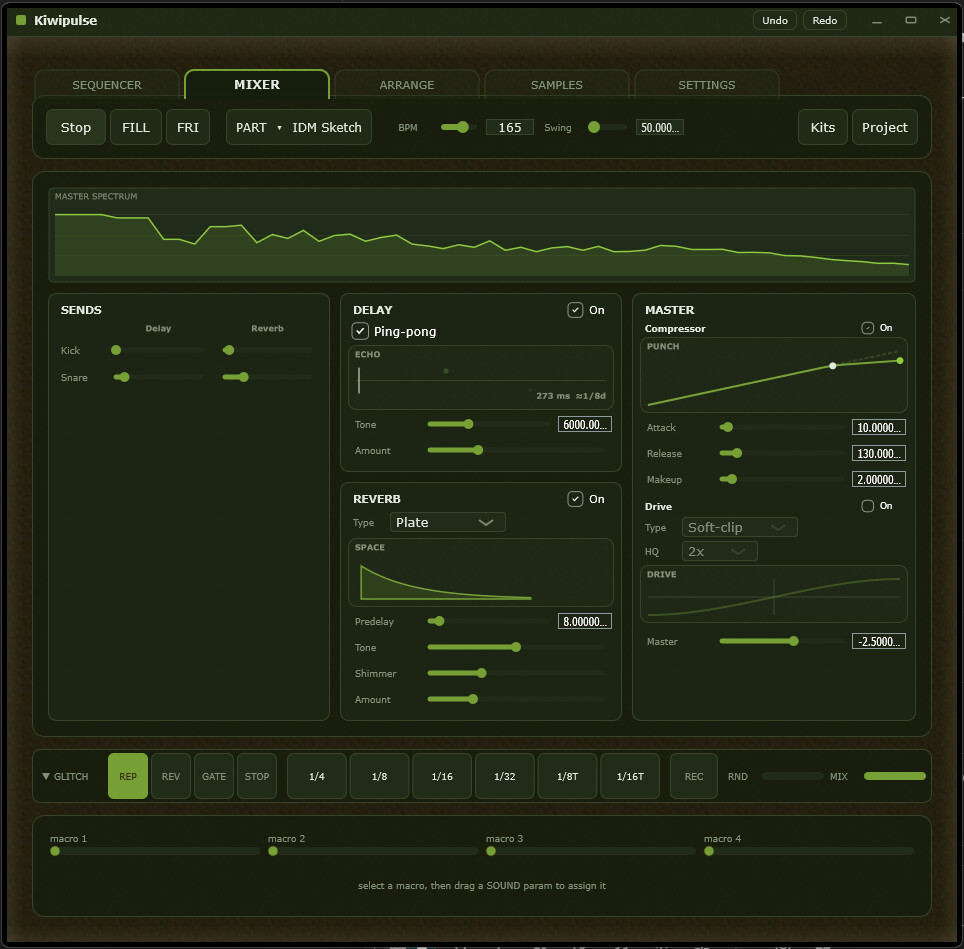
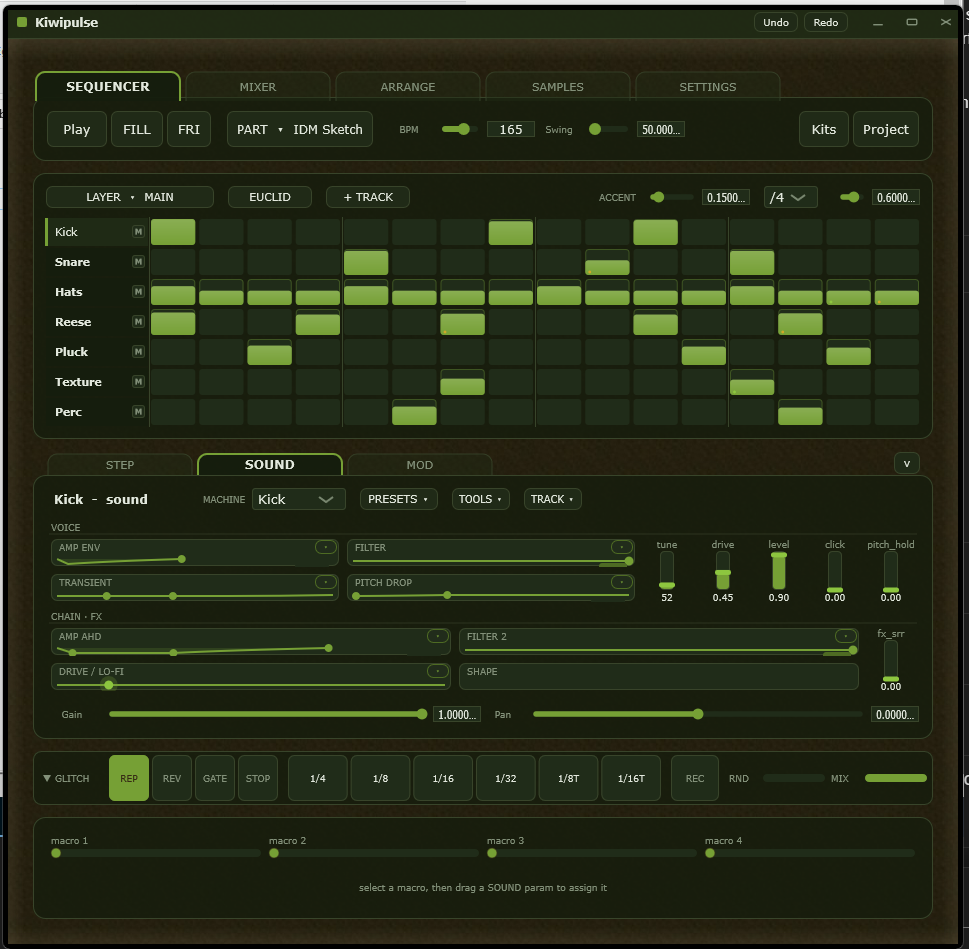
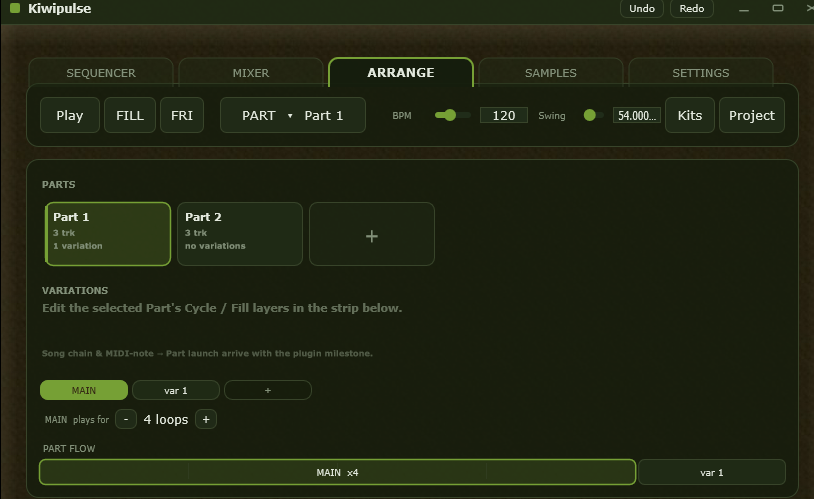
Well. When I came here, I didn’t really know what IDM was. I thought it was more like an industrial sub-genre of EDM.
Shame on me.
It’s far more technical and challenging than EDM. And the section-based arrangement grid I had in Kiwisonuc is pretty worthless for IDM. So that’s why I added the free-form grid with traditional patterns instead. I’m also going to add auto-repeat. So if you created a nice rhythmic phrase, you can simply drag it out (expand) on the arrangement grid, and it will auto-repeat.
But there is still something lacking that, from my understanding, is quite important for IDM, and that’s to be able to build that nice rhythmic groove with drums. Am I correct?
So yesterday I started researching drum machines, drum types, and their use in IDM. And now I’ve started with a drum machine. It will both work stand-alone as Kiwisynth and be integrated into Kiwisonic.
So what would be most useful for you in a drum machine? Think Elektron, but a futuristic madman came crashing down on it.
I can’t speak for others, but I have to use 3 different drum/sample softwares to be able to do everything I want with drums. I own a TR-1000 and it’s nice for jamming, but for serious sample manipulation I still need software of many varieties.
Algonaut Atlas 2 is what I use most of the time. It has a fun way to browse all your samples at once (if you just include a small, well chosen/managed sample set and make it easy to add additional samples this won’t be key, but I have well over 100GB of drums to sift through so it helps), but more importantly it has most of the basics you need for sample manipulation. Normalize, reverse, precise envelope control (though I have been asking them to add an option to set envelopes in synch with BPM for a few years which they haven’t done yet), basic tuning and filtering. And per-step randomization of pitch, velocity, pan, and even micro-timing. All good to have, but not enough in all cases.
There are two main cases in which I cannot use Atlas. 1. if I want to round-robin multiple similar samples on a single drum pad. I have an entire different sampler that I sometimes load up to use for single sound in a song because it can load 4 samples and play them back randomly, with the same per-step randomization of Atlas.
The other one I have to use sometimes is Slicex, if I want to slice a break and use that as my drum sounds instead. This one integrates better with FL studio (my daw) piano roll, so it does open up some automation options (especially pitch) that are nice, but that goes way beyond the remit of just being a drum machine and requires you to have the ability to sequence multiple parameters with every midi note in your main sequencer.
I think drum synthesis is interesting, but I have not gotten really good at it yet. It’s one of the more difficult types of synthesis to get good at because the sounds are so complex compared to standard subtractive tones. So if you want drums, my recommendation for most people is to stick to manipulating samples.
Drum synthesis is actually a lot easier than it sounds; usually putting some quick envelopes on a parameter or two will give you what you want. A kick drum can be synthesized easily with just a sine oscillator, hats with white or pink noise, and a snare with a combination of the two. For more interesting timbers, basic FM or additive synthesis will have you covered.
You can start with some preset parameters and then let the user adjust them just enough to create their own interesting sounds without going totally off the rails, so to speak. Most drum synthesizers do just that, in a nutshell.
Giving some access to baseline / offset values (+), attenuverters (*) and even the ADSR envelopes themselves can give the user quite a lot to work with, not to mention other forms of modulation for those more complex and metallic sounds you’ll inevitably want later
That’s basically what I did in some of my first tutorials for Metasounds a few years ago (to show how to make game music in UE just with Metasound oscillators so everything could be changed from within games basically). It’s straightforward and fun to set up and it works fine, but it can be hard to get it to sound just the way you want. Just speaking for myself, of course, but I can’t claim with a straight face that I’m still perfectly happy with the sound of the drums in those vids
I still sometimes synthesize drums for tracks from scratch, but very rarely all the drum for a complete track and mostly for fun if I want to play around with a synth or want to modulate the sound a lot. It just takes much more time until I’m really happy with the result on the day-after test compared to using a fitting sample. Especially for snares. Creative percussion is a whole other story, and any crazy sound can add something to a beat. But if we are talking about a really good sounding snare that I want to have in my track fast, I usually reach for a sample…
So I would definitely recommend to integrate both sample import and oscilaltor-based drum synthesis.
Some partly less common functions I like in drum machines and similar stuff:
glitch functions (f.e. very simple repeater and distortion options in Nerve, more interesting pseudo-microediting in Breaktweaker)
big number of pads/tracks with fast access
stepwise randomization of parameters
swing
flexible pattern length of individual tracks
controlled switching between patterns
excessive sound design or shaping options, but also
sample import
I would love something with the flexibility of Ableton Drum Racks, the microediting stuff from Breaktweaker and some functionality from Nerve (f.e. the live repeater buttons, but with a record or randomization function).
Reverse beat slice function that triggers in real time
Adsr envelopes for filter phase volume panning etc.
A compressor function
Transient shaper modulation
Micro editing
Sample looping randomization
Different aka odd time signature beat syncing
Ability to layer different drum racks/loops and modulate the beat sync with an lfo or randomize it…in addition to randomizing or modulating which portions of the different drum racks/loop trigger during playback as the above feature are applied according to the users liking.
Its like an fm synth but with noise oscillators and a built in compressor + transient shaper that has an automation sequencer+lfos that modulates all the different parameters according to the envelope sequence that you draw in
Its a kind of drum machine where as it has my peak controller trick as a function to an fm synth like fls sytrus.
My peak controller trick is basically me taking a drum loop and using the drum loop as an lfo shape sequence to control the volume of some sound designed noise that I’ve made while modulating the speed and adsr of the lfo shape from the drum loop sequence.
Tldr
Suggesting to incorporate my tricks into a single drum machine.
Envelope followers are almost a DAW staple now. Sort of like how MSEGs took over in the past few years, it just feels wrong for a DAW not to have one if it’s focused on modulation at all. Sometimes this even applies to singular synths, too.
If the script functionality can read from audio buffers and audio sources, that would be one way to do it, especially since generating modulation can (in theory) already support basic LFO / EG functionality. I’m really interested in testing this part most of all to see what it can / can’t do, because modulating the attenuation (as in your example) should be as simple as plugging in some basic multiplication, and maybe even connecting some kind of a GUI slider to it for better feedback. If that’s not a thing yet, macro controls inside of the scripting interface could really add some pzazz.
Hopefully I can provide some better feedback over the weekend as well. I’m going to redownload the newest build and hopefully give it a few solid hours.
You can define a set of patterns, like stick, verse or whatever you would like to call them. And for each pattern you can add variations and lay them out so that you play the regular patten 4 times and then a filler. Rinse and repeat.
All that are inside Kiwipulse. Right now I’ve added so that you bind each pattern to an midi note. So as long as you drag out a note, for instance, C2 the first pattern (verse) is played & repeated.
That’s a good option, but I’d like to be able to sequence each drum directly as well. Usually this is accomplished by having each drum mapped to one midi note. So maybe a pattern mode like you have now and also a kit mode that lets you sequence it directly from the piano roll.


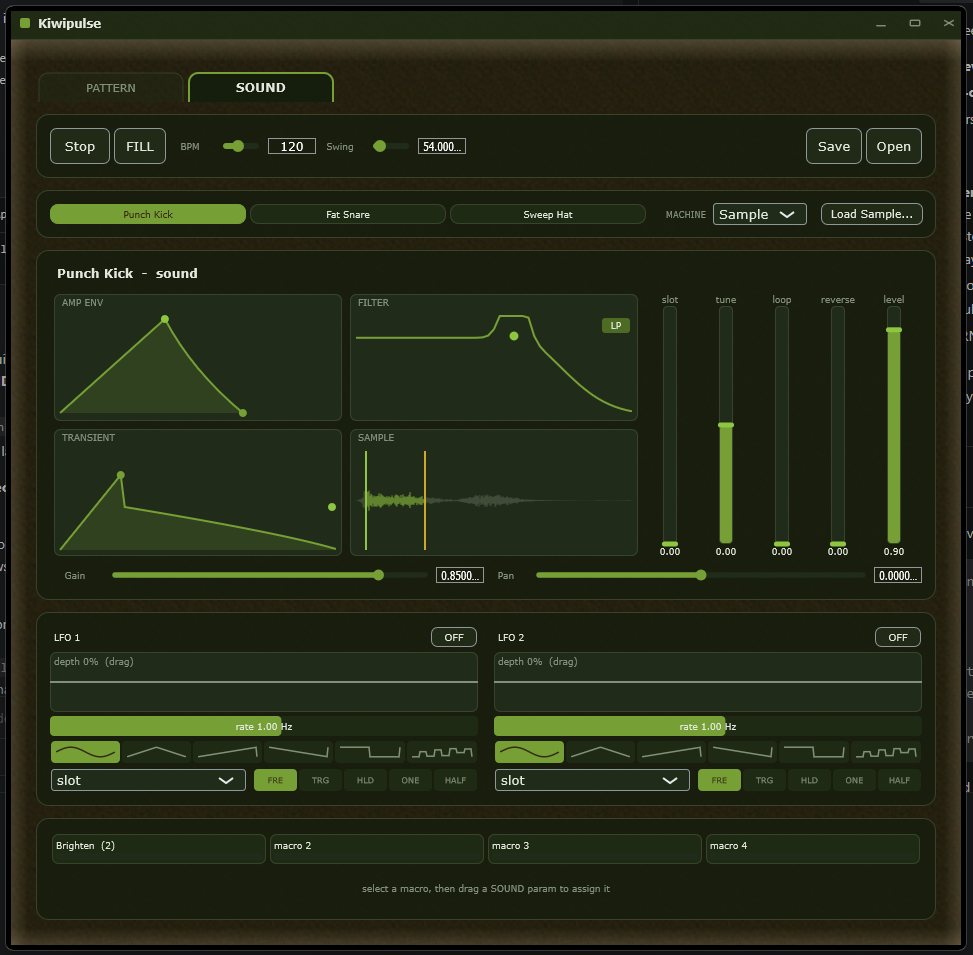
 Thanks. I’ve written them down.