Hah, I must have gotten to this just at the right time. I’ve been checking it out for the past few minutes; UI boots and everything looks good, but it doesn’t seem to output audio. It can’t find my soundcard, so that seems to be the issue so far. I can’t tell whether it can find its internal instruments correctly until that’s fixed, but I directed it back toward its own folder just in case. All of the visual modes seem to be operational, though, and it certainly looks pretty slick so far.
Is there a ‘MIDI output’ option planned? That would be one way to see if at least something’s happening underneath, as I could route it through my loopback just as a test.
I’m also going to check out the synth itself in VST format and see what’s going on there, too. I just noticed that there were two separate components to this, so that’ll be the next stop
Exporting MIDI seems to work, so I think the missing link is in fact just the audio output. That’s a good sign.
Anything compatible with ALSA, Pipewire, PulseAudio, Jack, etc should usually work fine. Many different systems use whatever they want under the hood and it seems to work great, but since I don’t have any hardcore development experience, that’s about where my knowledge ends. I’ve definitely built environments from source using different audio drivers and protocols and thus far, pretty much everything seems to work across the board when the implementation is right.
I’m on Zorin 18.1, but I can also sandbox under another distro if you have a hunch it might work better under Ubuntu or something like that. I’ve had a lot of luck doing that lately, as well.
v0.8.8 plays audio on linux. But the synth settings (the cog wheel right of instrument selector) crashes the app. Checking that now.
I also added a free form arrangement grid since section based arrangements isnt a good fit for IDM. Free form is more like traditional pattern based arrangements.
There is a toggle button on top of the grid for it.
A question: in which paths should Kiwisonic try to find VST/CLAP on linux?
They’re usually not standard like they can be elsewhere (and often default to totally random places upon installation), so a lot of music programs use either one or multiple custom directories to sort of wrangle them all.
ahh ok. The settings dialog contains a tab for VST paths.
I think I’ve found the synth crash. Will try it soon.
I also added three patches that I hope you’ll like.
Glass Carillon: FM algorithm “Dual Pair” (Osc2 to Osc1, Op4 to Osc3), Op4 ratio 7.02 with a 1.002 global offset for inharmonic beating; fast-decay modulator envelopes over long-release carrier envelopes; velocity and keytrack to FM depth.
Driftfield: Osc1 granular over the bowed-metal sample, Osc3 granular over a wavetable scan; 0.05 Hz LFO to grain position, second LFO to grain size, S&H to pitch jitter, macro to density/spray/size; comb filter, foldback distortion, long-mode reverb with octave-up shimmer.
Mangler: Two wavetables through osc wavefold then sample-rate decimate into a MGLow24 ladder at 0.8 resonance; StepSeq1 to filter cutoff, StepSeq2 to Osc1 WT position, S&H to decimate depth, velocity to fold amount, random to Osc2 detune; tempo-synced stutter delay.
Ok. v0.8.14 should load OK. The synth is slow first time you open it from Kiwisonic, but once loaded it should be fast. Going to fix the initial load later.
Here is another crazy idea. What do you think about recording your voice, pitch track it, normalize and build a single cycle wavetable from it? A hum oscillator.
Actually, this could be pretty cool for humming a melody and getting it into the project as fast as possible. Would fit right in with the ethos of not needing to know a lot of music theory to make music. Like, even if you just get the pitchtracking right and can add notes to the piano roll from voice controlling a synth, that would be sick. I think that kind of thing has been done, but not integrated at the paino roll/daw level.
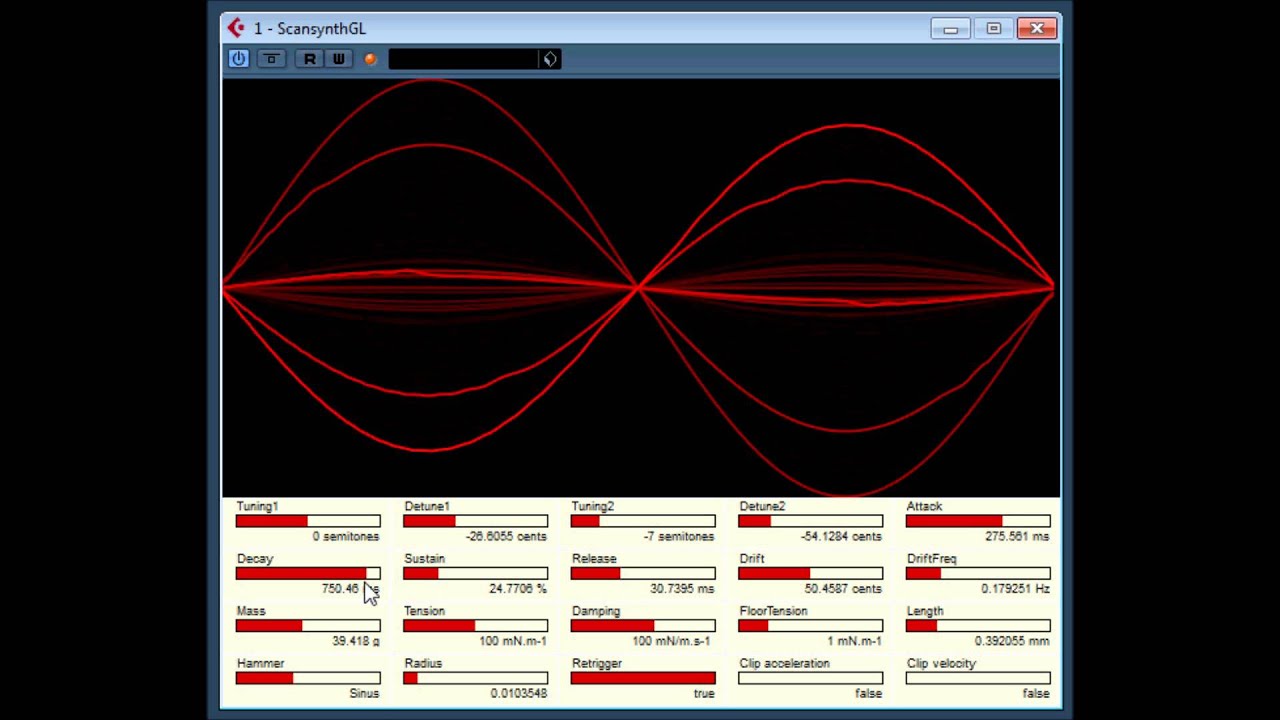
I think the scanned synthesis thing sounds similar to what Waldorf are doing with the Seeds mode in Iridium MK2. If you’re looking for inspiration.
That’s what a lot of wavetable synths already sort of do as an ‘extra’ feature where you import audio into the bank directly (Vital, Serum, etc) but implementing your own is a great idea, too. You can’t really have too many awesome sound processors, IMO, and if you end up mixing it with granular synthesis, you might end up with something really unique in the process.
Hopefully within the next few days I can give the new Linux build a spin. I’m genuinely excited about this