I’d start with the official tutorials. Cycling has done amazing work making their product well documented and approachable despite the complexity. Everything has practical and interactive examples to work with and is explained in a straightforward way. They’ll ease you into the ecosystem.
Start with the basic Max tutorials to understand the layout and common objects. Everything through Numerical User Interfaces. You can skip the drawing and movie stuff if you want, come back to it later if it’s relevant. Encapsulation, Remote Messaging and Abstractions are very important down the line as organizational tools but you can get by without them early on.
Those first few sections will get you familiar with Max in general - making objects, hooking things up, data flow etc. I would do the MIDI section while you’re there.
Finish out the Max tutorials or skip them for now, move on to the MSP tutorials. This is all audio rate things - synthesis, samples, DSP, etc. None of this is strictly about what you’re asking, but for me it’s where Max’s power is and the parts I gravitate towards. At the very least you’ll be able to set up simple noise makers so you have some output to listen to.
What you’re specifically looking for is Audio-rate sequencing. That in conjunction with everything else on the list should give you a starting point for what we’re talking about (timing manipulation, ramps, probability, and so on).
It’s worth pointing out because it’s not immediately obvious - even if you have zero interest in video, the JIT environment and objects can be useful. They’re built to handle large amounts of vectorized data and can be useful in storing and processing large list of numbers (like FFTs of audio data). It’s fair to make it last on the list, but a passing familiarity with JIT can be handy if you’re really into Max data.
Beyond the tutorials, the gold standard for deep Max learning is the book Generating Sounds and Organizing Time (usually referred to as GO in Max circles). It is written as straightforward as the Cycling tutorials, but the subject matter is much more in depth and complex, so it’s harder to approach in some sections. But it’s good. So, so good. Explicitly, Chapters 2 and 3 are a very comprehensive look at what we’re talking about regarding “Autechre-style rhythms”.
Past that, you just branch out in the usual ways - Max Facebook groups are surprisingly active and people share patches. The Cycling Discord and forums have years of knowledge and people to answer questions as well as patches to dissect. There are some youtube channels that do Max related content, though I’m not much of a video watcher so I’m not terribly familiar with them.
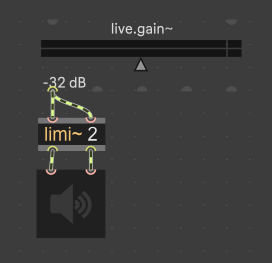
Lastly, some practical advice. Read the section on Abstractions. Create one that has an dac with your preferred output, a limiter (limi~), and a volume slider (live.gain~) set to halfway. Use this in all your patches while you’re learning, and feel confident to experiment. The limiter and volume slider means you won’t blow your ears or speakers, so you can hook up anything to anything without fear. If you find yourself wondering “what happens if I do this?”, try it and find out.


 But you can maybe see where you can fit in probability for things like whether to grab another S&H datapoint to change the swing curve or tempo so you get this endlessly morphing timing.